
 1 / 3


Double Shaft Plastic Shredder
Heavy-duty dual-shaft shredder with aggressive hook blades for high-volume processing of tires, MSW, industrial waste, and mixed plastics. Available in 8 models from 7.5kW×2 to 110kW×2.
The ZDS-HD Series is a heavy-duty double shaft plastic shredder built around two counter-rotating hook-type blade shafts. Depending on model, 7.5 kW × 2 to 110 kW × 2 of drive power turns 20 to 100 blades to process 200-5000 kg/h, with output controlled between 40 and 150 mm by blade spacing. It is chosen where thickness and contamination set the limit — thick-walled pipe, pallets, industrial waste and municipal solid waste — rather than where a fine, uniform particle is the goal.
Technical Specifications
| Model | ZDS-HD400 | ZDS-HD600 | ZDS-HD800 | ZDS-HD1000 | ZDS-HD1200 | ZDS-HD1500 | ZDS-HD1800 | ZDS-HD2000 |
|---|---|---|---|---|---|---|---|---|
| Motor Power | 7.5kW×2 | 11kW×2 | 15-22kW×2 | 30-37kW×2 | 37-55kW×2 | 55-75kW×2 | 75-90kW×2 | 90-110kW×2 |
| Shaft Speed | 16-24 RPM | |||||||
| Blade Qty | 20 pcs | 30 pcs | 40 pcs | 50 pcs | 60 pcs | 75 pcs | 90 pcs | 100 pcs |
| Blade Material | SKD-11 Alloy Steel (Hook Type) | |||||||
| Throughput | 200-300 kg/h | 300-500 kg/h | 500-800 kg/h | 800-1200 kg/h | 1200-1800 kg/h | 1800-2500 kg/h | 2500-3500 kg/h | 3500-5000 kg/h |
| Output Size | 40-150 mm (blade spacing controlled) | |||||||
Double Shaft Plastic Shredder ZDS-HD Series
The ZDS-HD series double shaft shredder features independent twin-motor drive with SKD-11 alloy hook-type cutting blades for the most demanding shredding applications. Its aggressive blade geometry and high-torque, low-speed design handles everything from end-of-life tires to mixed municipal solid waste with metal contamination.
Key Features
- Dual independent motor drive system for balanced torque distribution
- SKD-11 alloy steel hook blades with extended service life
- Automatic reverse rotation on overload to prevent blade damage
- Low-speed, high-torque design minimizing noise and dust generation
- Siemens PLC touchscreen control panel with real-time monitoring
- Heavy-duty planetary gear reducer built for 24/7 continuous operation
- Reinforced hopper with integrated safety screens and emergency stops
- 8 model sizes for processing capacities from 200 to 5000 kg/h
Processing Materials
Waste tires, plastic pallets, IBC containers, plastic drums, sheet materials, plant straw and biomass, municipal solid waste, animal carcass (harmless treatment), construction and demolition debris, wood pallets.
Applications
Tire recycling plants, municipal solid waste processing, bulky industrial waste pre-treatment, biomass and wood recycling, medical waste disposal (post-sterilization), construction and demolition waste sorting.


What the HD Series Is Built For
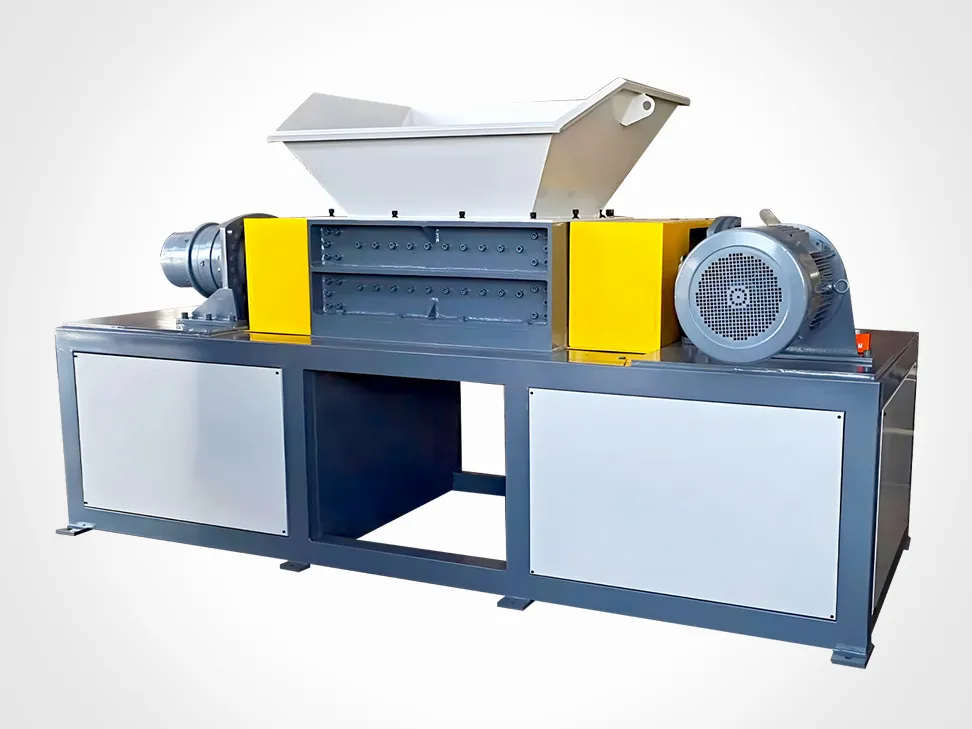
The ZDS-HD is the machine for material that fights back: thick-walled PVC and HDPE pipe, large blow mouldings, drums, bales, e-waste housings and mixed industrial scrap. Hook-type knives on two counter-rotating shafts grab and tear rather than shear, and blade quantity scales with the machine — 20 knives on the ZDS-HD400 up to 100 on the ZDS-HD2000 — so larger stock can be engaged at several points at once.
Output spans 40–150 mm, controlled by blade spacing. Across the series throughput runs from 200–300 kg/h on the smallest model to 3,500–5,000 kg/h on the ZDS-HD2000, with motor power from 7.5 kW × 2 to 90–110 kW × 2.
Position in the Line
This is a primary reduction machine. The 40–150 mm output feeds a heavy duty crusher, which brings it into the 8–20 mm range used by extruders and injection machines. Powder production adds a vertical disc pulverizer as the third stage, accepting feed of 10 mm and below.
Plants that only need a coarse, transportable product — for washing lines or for shipping to another facility — sometimes stop after the shredder, and that is a legitimate configuration. The decision hinges on what the next process accepts.
Selecting a Model
Start from the largest single item in your feed. Hook knives need to engage the piece before they can pull it through, and a machine with too small a cutting chamber will stall on stock it cannot grab, regardless of motor power. Once the chamber size is settled, throughput and knife count determine the model.
Contamination is the second factor. Heavily contaminated scrap with metal or mineral content justifies the next size up, because the drive and shafts absorb shock that would otherwise be carried by the knives alone.
Operating Notes
Blade spacing is the main control an operator has, and it trades output size against throughput and load. Running at the wide end of the 40–150 mm range maximises throughput but pushes more work downstream. Running narrow gives a better feed for the granulator at the cost of rate and power draw.
Hook knives wear at their tips and are re-ground before replacement. As with all SKD-11 tooling, the interval depends on the feed — clean pipe scrap and demolition-grade mixed waste are not comparable, and no manufacturer can quote a wear life without knowing which one you have.
Related Reading
Frequently Asked Questions
Scale and duty. The HD series runs larger cutting chambers, more knives (20 to 100 depending on model) and higher twin motor power — up to 90–110 kW per shaft — so it is aimed at thick-walled pipe, blow mouldings, drums and bales rather than light scrap.
By blade spacing, adjustable across 40–150 mm. There is no screen. Wider spacing gives higher throughput and coarser flake; narrower gives a finer product at lower rate and higher load.
Yes, within the cutting chamber dimensions of the model. Thick-walled PVC and HDPE pipe is the stock this series is designed around. Very long lengths are usually pre-cut to a manageable size to avoid bridging the hopper.
The published range is 200–300 kg/h on the ZDS-HD400 up to 3,500–5,000 kg/h on the ZDS-HD2000. Those figures assume dense rigid material. Light or film-type feed will not reach the same rate on the same machine.
If the output is going to extrusion or injection, yes — 40–150 mm flake is far too coarse. If you only need a transportable, washable product, or you are shipping material elsewhere, the shredder output may be the end of your process.
They wear at the tip and are re-ground before being replaced. Wear rate is governed by the feed: clean pipe scrap is mild, mixed demolition waste with sand and metal is not. Screening the input is the cheapest way to extend knife life.

Interested in This Machine?
Tell us your material type, desired throughput, and output size — our team will provide a tailored recommendation and quotation.