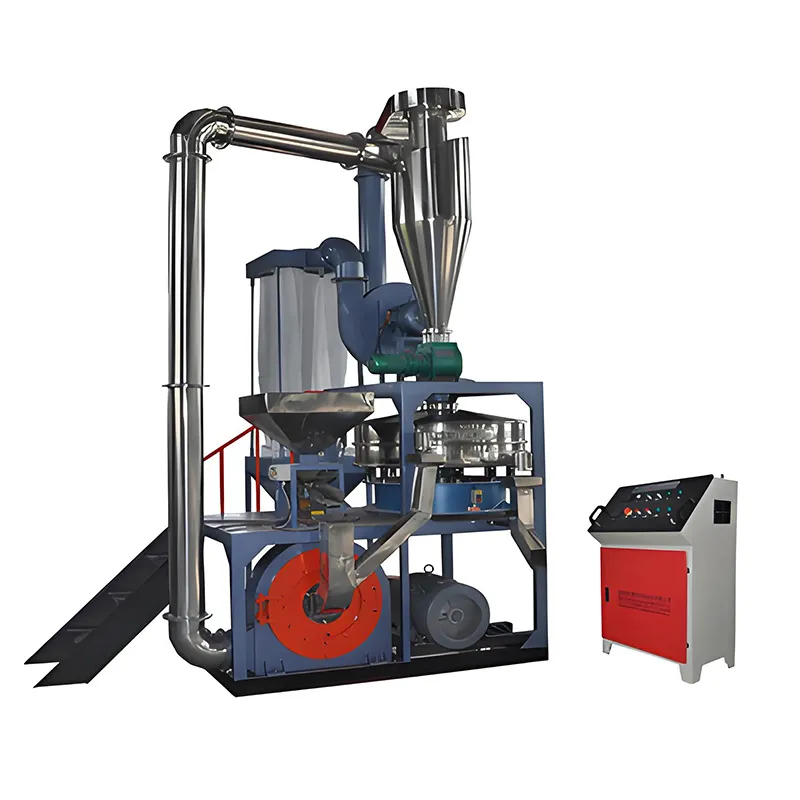
Vertical disc mills grinding PE, PVC, PP and LLDPE regrind into 10–150 mesh powder for rotomolding, masterbatch and WPC.
A plastic pulverizer is a disc mill that grinds plastic regrind into fine powder between two vertical discs. Zhiyi Machine builds two ranges. The MPD series handles PVC and mixed rigid plastics with water and air dual cooling. The MF series is configured for PE and LLDPE, including powder for rotational moulding, with a vibration screen classifier. Output ranges from 10 to 150 mesh at capacities from 50 kg/h to 1,200 kg/h, and both ranges accept feed no larger than 10 mm.
A pulverizer grinds rather than cuts. Regrind enters between a rotating disc and a stationary disc, and is reduced by a combination of shearing and attrition as it travels outward toward the disc rim. Because the material stays between the discs until it is fine enough, the process produces powder rather than granulate — typically 10 to 150 mesh depending on machine and setting.
The discs generate heat, and that is the main constraint on pulverizing. Thermoplastic powder softens and then smears on the disc face, which reduces output and contaminates the product. Both Zhiyi Machine ranges therefore include cooling: the MPD series uses water and air dual cooling on the main machine, and the MF series uses a water-cooled jacket on the grinding chamber. Disc design also matters, and the MPD range uses a high-resistance disc specified at twice the service life of a standard disc.
Fine powder is required wherever the material has to melt evenly and quickly. Rotational moulding is the clearest example — a rotomolding arm cannot distribute granulate evenly, so the charge has to be powder of a controlled particle size.
| MPD series | MF series | |
|---|---|---|
| Built for | PVC and mixed rigid plastics | PE and LLDPE, rotational moulding powder |
| Models | MPD-350 → MPD-800 (4 models) | MF-400 → MF-800 (4 models) |
| Disc diameter | 350–800 mm | 400–800 mm |
| Main motor | 22–110 kW | 22–110 kW |
| Output fineness | 60–150 mesh | 10–120 mesh |
| Capacity | 100–1,200 kg/h | 50–1,200 kg/h |
| Cooling | Water + air dual cooling | Water-cooled grinding chamber jacket |
| Classification | Cyclone + dust collector, sealed milling | Vibration screen classifier |
| Feed size | ≤ 10 mm | ≤ 10 mm |
The two ranges cover overlapping material lists but differ in emphasis. The MPD series is configured around PVC and mixed rigid feedstock, where heat generation is high and dust control matters. The MF series adds a vibration screen classifier, which suits PE powder intended for rotomolding, where particle size distribution is a quality requirement rather than a preference.
| Fineness | Typical use | Notes |
|---|---|---|
| 10–40 mesh | Coarse powder, some extrusion feeds | Highest throughput; may be too coarse for thin-wall rotomolding |
| 40–60 mesh | General rotomolding, WPC extrusion | Common working range for PE powder |
| 60–80 mesh | Rotomolding where surface finish matters | Finer powder melts more evenly on the mould wall |
| 80–120 mesh | Masterbatch, compounding, coating | Requires stable cooling to avoid disc smearing |
| 120–150 mesh | Fine-grind applications | Lowest throughput; confirm the machine can hold this range |
Mesh number is not the whole specification. Two powders at the same mesh can behave differently in a mould if their particle size distributions differ, which is why rotomolding customers usually work to a distribution target rather than a single mesh figure. The MF series addresses this with a vibration screen classifier rather than relying on the mill setting alone.
Both pulverizer ranges accept feed no larger than 10 mm. This is why a pulverizer is almost always installed downstream of a crusher: the crusher produces the 6–20 mm regrind that becomes the pulverizer feed. Feeding oversize material causes the discs to part under load, which produces inconsistent powder and accelerates wear.
Cooling capacity should be selected against the hardest material you intend to run, not the easiest. A machine that runs comfortably on PE powder in cool ambient conditions can struggle with rigid PVC in a warm plant. If the plant produces several materials, cooling headroom is worth specifying at the outset rather than adding later.
Decide the mesh range the downstream process needs, then select the model that holds that range at the required rate. Specifying a machine from capacity alone often produces powder that is either too coarse or produced at an unrealistic rate.
PE and PVC behave differently under grinding. The MF series is configured for PE and LLDPE, particularly rotomolding powder. The MPD series is configured for PVC and mixed rigid plastics with heavier cooling and sealed dust control.
A pulverizer is the last stage, not a standalone machine. It needs crusher regrind at 10 mm or below, dry material and a dust collection arrangement. Plan the shredder, crusher and pulverizer as one chain so the handover sizes line up.
For selection guidance by material type, see choosing a pulverizer for PVC, PE and WPC, and for particle size distribution in rotomolding, see rotational moulding powder and particle size distribution.
Most rotomolding applications work in the 35–80 mesh range, with the precise target depending on wall thickness and part geometry. Thin walls need finer powder that melts quickly; heavier sections tolerate coarser material. The distribution matters as much as the mesh number.
Only if you already have material below 10 mm. PVC pipe, profile and flooring offcuts are far larger than that, so a shredding and crushing stage is normally required to bring the material into the pulverizer's feed range.
The most common causes are worn disc segments, material smearing on the disc face from insufficient cooling, a blocked classifier screen or feed that has drifted above the 10 mm limit. Checking disc condition, cooling flow and feed size in that order usually identifies the cause.
Strongly. Softer materials grind faster and reach finer mesh more easily, while hard or highly filled materials reduce both throughput and achievable fineness. Capacity figures are always quoted for a specific material and mesh target.
Yes. Fine plastic powder is a housekeeping and safety concern as well as a product loss. The MPD series uses a fully sealed milling chamber with cyclone and dust collector; the MF series uses a vibration screen classifier in the same closed circuit.
The MPD series is built around PVC and mixed rigid plastics, with water and air dual cooling and sealed dust control. The MF series is built around PE and LLDPE, particularly rotomolding powder, and adds a vibration screen classifier for tighter particle size distribution.