
Flat-blade and claw-blade granulators producing uniform 6–20 mm regrind for injection moulding, extrusion and recycling lines.
Showing 2 products in this category

Plastic Crusher Machine
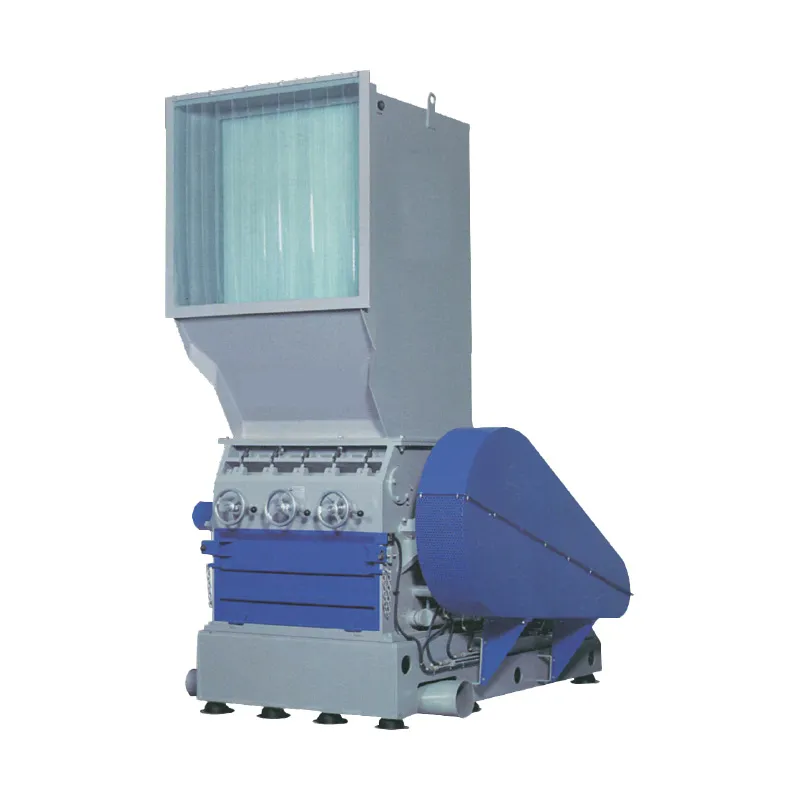
Plastic Crusher Machine
A plastic crusher, also called a granulator or granulating machine, is a high-speed machine that cuts plastic scrap into uniform regrind for reuse in moulding or extrusion. Zhiyi Machine builds two ranges. The ZPC universal series uses flat paddle blades for sprues, bottles, thin-wall parts and light regrind. The ZPC-HD heavy duty series uses claw blades for thick sections, pipes, purgings and dense moulded parts. Both produce screen-controlled output between 6 mm and 20 mm, at rates from 150 kg/h to 2,200 kg/h.
A crusher cuts by impact and shear at high rotor speed — 580–650 RPM on the ZPC series and 500–580 RPM on the ZPC-HD series. Material drops into the cutting chamber and is caught between rotating blades and stationary bed knives, then held in the chamber until it is small enough to pass through an interchangeable screen. Because the screen sets the maximum particle size, the output is far more uniform than the flake produced by a shredder.
That uniformity is the point. Regrind that feeds an injection moulding machine or an extruder has to melt at a predictable rate, and a wide spread of particle sizes causes uneven melting, surging and inconsistent part quality. A granulator is the stage that delivers a consistent regrind.
Crushers are also used inline. An injection moulding shop running sprues back through a granulator beside the press recovers material without sending it off site, which is usually the fastest return on a crusher investment.
The two terms describe the same machine. North American processors generally say granulator, while European and Asian suppliers and buyers more often say crusher. Equipment catalogues, spare-part lists and job postings use both, and a machine sold as a plastic crusher will be found under granulator in another supplier's range.
| Series | Blade type | Models | Motor power | Rotor speed | Screen | Throughput |
|---|---|---|---|---|---|---|
| ZPC | Flat (paddle), SKD-11 | ZPC-500 → ZPC-1200 (6 models) | 11–45 kW | 580–650 RPM | 6–20 mm | 150–1,000 kg/h |
| ZPC-HD | Claw (prong), SKD-11 | ZPC-HD800 → ZPC-HD1600 (5 models) | 45–132 kW | 500–580 RPM | 8–20 mm | 700–2,200 kg/h |
The ZPC range carries 9 to 24 rotor blades depending on model, with 2 to 6 stationary blades. The ZPC-HD range carries 15 to 30 rotor blades and adds a wider cutting chamber, from 800×600 mm on the ZPC-HD800 up to 1600×1000 mm on the ZPC-HD1600.
| Blade type | Cutting action | Best for | Series |
|---|---|---|---|
| Flat (paddle) | Shear across a straight edge | Sprues, bottles, thin-wall parts, film flake, light regrind | ZPC |
| Claw (prong) | Grips and pulls material into the cut | Thick sections, pipes, purgings, dense mouldings, WPC | ZPC-HD |
A flat blade slices cleanly through thin and brittle material. It has little ability to grip, so thick or slippery sections can bounce on the rotor instead of being cut. A claw blade hooks into the material and pulls it through the chamber, which is what allows the heavy duty range to process solid blocks. The trade-off is that claw blades produce a slightly less uniform granulate and cost more to replace as a set.
For a detailed comparison of blade geometry and replacement practice, see claw vs flat blades and the blade replacement guide.
The screen is the single most direct control over regrind size, and it is interchangeable on both ranges. A 6–8 mm screen produces fine regrind, suitable when the material returns to a precision moulding process. A 12–20 mm screen runs faster and produces coarser granulate, suitable when the regrind feeds an extrusion line that can accept it or when throughput matters more than fineness.
Screen choice always trades throughput against fineness. Reducing output size increases the time material spends in the chamber, so a smaller screen lowers kg/h for the same motor. When specifying a crusher, quote the screen size you intend to run, because the headline throughput figure is measured against a specific screen.
Thin, brittle material suits flat blades. Thick, dense or slippery material needs claw blades. Running the wrong geometry is the most common cause of slow feed and premature blade wear.
A crusher will not accept anything larger than its chamber opening, and forcing oversized parts in damages blades. Estimate the largest single item that must pass through, not the average size of the stream.
A granulator beside an injection press is sized to that press's scrap rate. A central granulator serving a whole plant is sized to the total, and usually needs a larger chamber and a material handling arrangement around it.
They are the same machine under two names. North American processors usually say granulator, while European and Asian suppliers usually say crusher. When comparing quotes, check rotor speed, blade type, screen size and chamber dimensions rather than the category name.
Only for bulky or thick-walled material. Sprues, small mouldings, bottles and flake can go straight into a crusher. Pipes, purgings, pallets and bales are too large or too solid to feed directly and are shredded first.
Match it to the next process. Precision moulding usually needs 6–10 mm; general extrusion is comfortable with 10–20 mm. A smaller screen gives finer regrind but lower throughput, so the choice is a balance rather than a fixed rule.
Yes, but these materials are denser and more abrasive than polyolefins, so claw blades and a heavier drive are usually appropriate. Blade wear can be faster, and the screen should be selected with the downstream pulverizing stage in mind if powder is the final product.
High rotor speed makes a granulator louder than a shredder, and noise rises with material hardness. Enclosure, correct blade clearance and stable feeding all reduce it. Confirmed sound pressure levels for a specific model and material should be verified at the quotation stage rather than assumed.
Usually a worn or badly set blade gap, a damaged screen, or feeding faster than the rotor can process. Check blade clearance against specification, inspect the screen for deformation, and confirm that material is not bypassing the chamber edge.