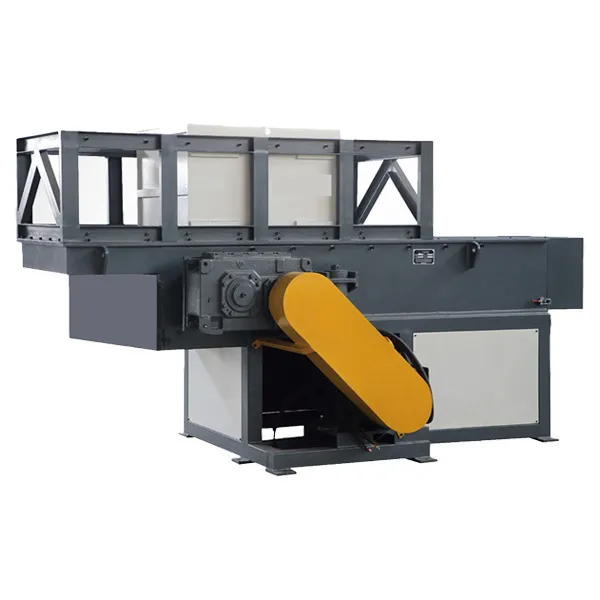
Single shaft, combo and double shaft shredders for pipes, purgings, films, woven bags, pallets and mixed rigid plastic waste.
A plastic shredder machine is a low-speed, high-torque industrial machine that reduces bulky plastic waste into 40–150 mm flakes in a single pass. Zhiyi Machine builds three shredder families. The ZSS single shaft series uses hydraulic ram feeding for pipes, purgings and films. The ZDS combo series combines single and double shaft cutting for mixed and lightly contaminated streams. The ZDS-HD double shaft series uses hook-type blades for the heaviest duty, up to 5,000 kg/h.
A shredder cuts by shear rather than by impact. Material enters through a hopper and is pushed toward a rotating rotor carrying bolt-on blades. Because the rotor turns slowly — 70–80 RPM on the ZSS series and 16–24 RPM on the ZDS and ZDS-HD series — each blade applies very high torque to a small section of material instead of striking it at speed. That is what allows a shredder to bite into a thick HDPE pipe wall or a solid purging without stalling.
The size of the output is set by a screen mounted under the rotor. Material stays in the cutting chamber until it is small enough to pass through the screen openings. On the ZSS series the screen can be changed between 40 mm and 100 mm; on the ZDS-HD series the effective output is controlled by blade spacing, giving a 40–150 mm range.
Feeding is the limiting factor on most shredder installations. Bulky and hollow items do not settle into the rotor on their own, so the ZSS series uses a hydraulic ram with automatic compaction to press material into the cutting chamber at a controlled rate.
| Series | Cutting system | Models | Motor power | Speed | Throughput | Output |
|---|---|---|---|---|---|---|
| ZSS | Single shaft + hydraulic ram | ZSS-600 → ZSS-2000 (6 models) | 22–160 kW | 70–80 RPM | 200–2,000 kg/h | 40–100 mm |
| ZDS | Combo single / double shaft | ZDS-600 → ZDS-1500 (5 models) | 22×2 – 132×2 kW | 16–24 RPM | 500–1,800 kg/h | 40–120 mm |
| ZDS-HD | Double shaft, hook blades | ZDS-HD400 → ZDS-HD2000 (8 models) | 7.5×2 – 110×2 kW | 16–24 RPM | 200–5,000 kg/h | 40–150 mm |
All three ranges use SKD-11 alloy steel blades in a bolt-on design, so a worn blade is replaced individually rather than by changing the whole rotor. The ZDS and ZDS-HD series use dual planetary gear reducers to transmit torque to two shafts.
| Feedstock | Recommended series | Notes |
|---|---|---|
| HDPE / PP pipes | ZSS single shaft | Hydraulic ram keeps long sections feeding steadily |
| Purgings and lumps | ZSS single shaft | High torque required; screen sets the flake size |
| Film and woven bags | ZSS or ZDS | Low bulk density; often shredded before granulating |
| Pallets and crates | ZDS-HD double shaft | Hook blades grip and pull rigid items down |
| Mixed / contaminated plastic | ZDS-HD double shaft | Tolerates some non-plastic content better than single shaft |
| Large-diameter pipe | ZDS-HD double shaft | Wide cutting chamber handles full sections |
| IBC tanks and drums | ZDS-HD double shaft | Up to 5,000 kg/h on the largest model |
Feed size matters as much as material type. A shredder accepts items that a granulator cannot, but there is still a practical upper limit set by the hopper opening and cutting chamber width. Oversized items should be reduced in size before feeding, or fed as part of a mixed load.
Two materials with the same weight per hour can require very different machines. A tonne of HDPE pipe regrind and a tonne of LDPE film occupy completely different volumes and put different loads on the rotor. Describe the material first, then the capacity target.
Hydraulic ram feeding with automatic compaction is not optional for pipes, purgings and hollow items — without it the material bridges above the rotor and the machine runs empty. For material that flows into the chamber by gravity, a simpler feed arrangement is adequate.
If the shredded material goes straight to a granulator, a 40–100 mm screen is usually appropriate. If it is shipped as-is or fed to a different process, a wider screen may be acceptable. The screen is the cheapest variable to change later.
Blade life depends on the material. Abrasive fillers, glass-filled grades and contaminated streams shorten the interval; clean polyolefin regrind extends it. Bolt-on blades mean the rotor does not have to be removed for servicing, which keeps that downtime short.
Keep the ram stroke matched to the material. Feeding faster than the rotor can cut causes the chamber to fill and the drive to draw high current; the PLC control on the ZSS series includes overload reverse and auto-stop protection for this condition. Screen changes should be planned rather than reactive, because a partially blocked screen reduces throughput before it becomes visible in the product.
For the wider context of how a shredder fits into a complete recycling line, see shredder vs crusher: what the difference means for line design and single shaft vs double shaft shredders.
It depends on pipe diameter and wall thickness rather than weight alone. A single shaft shredder with hydraulic ram feeding is the usual choice, because full pipe sections will not feed reliably without positive pushing. Match the hopper opening to the largest section you intend to feed, then size the motor from the required kg/h.
Yes, but film behaves differently from rigid plastic. Its bulk density is very low, so a shredder reaches its volume limit long before its weight limit, and output is quoted in kg/h at a much lower figure than for rigid regrind. Film is usually shredded to a coarse flake and then granulated.
Shredder pricing depends on the model, motor size, feed system, blade configuration and screen set, so machines are quoted per configuration rather than from a list price. Share your material, target throughput and required output size and you will receive a specific configuration and quotation.
A single shaft shredder uses one rotor with a screen and usually a hydraulic ram, giving tighter control over output size and more consistent flake. A double shaft shredder uses two counter-rotating shafts with hook blades, which grips difficult items and tolerates mixed or contaminated feedstock better. Double shaft machines generally produce coarser output.
This depends on the material. Abrasive fillers, glass-filled grades and dirty streams wear blades quickly, while clean polyolefin regrind allows much longer intervals. Watch for rising motor current, coarser output and slower feed as the practical signals that blades need attention.
Not in one pass. Even with the smallest screen setting, a shredder produces flakes rather than uniform granules, and the particle size distribution is wider. If the material goes back into an extruder or moulding machine, a granulating stage after the shredder is the normal arrangement.