
Shredding Wood, Fiberglass and Steel Drums: What Changes on the Same Machine
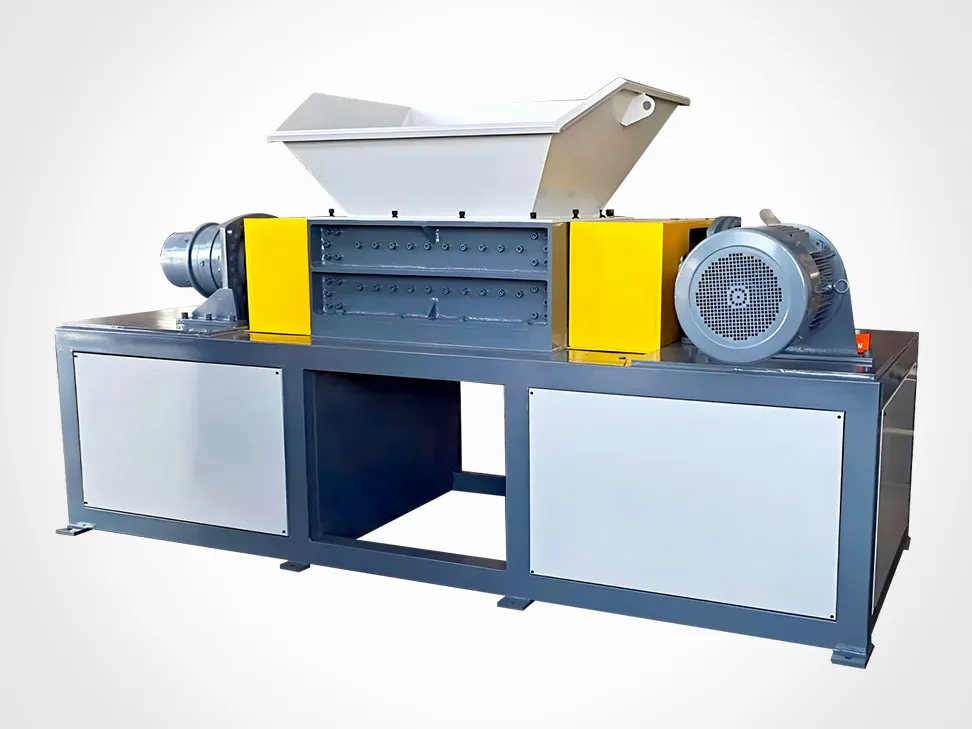
Most enquiries that arrive described as "plastic recycling" turn out to include something else. A plant recovering plastic film also has pallets. A composites workshop has fiberglass offcuts and cured resin. A chemical or coatings operation has empty steel drums going out as waste.
The good news is that the same slow-speed shredding platform handles all of it. The bad news is that "the same platform" is not the same as "the same machine". This guide covers what actually changes when you move from plastics to wood, fiberglass, metal and textiles — the material families listed on our material solutions page.
Why one platform covers so many materials
Slow-speed, high-torque shredding works on a principle that is largely material-agnostic: apply enough force through a small number of robust cutting edges to break the structure apart. That principle does not care much whether the structure is a polymer, a cellulose composite or a steel shell. It only cares about the forces involved and how the material fails.
Three things then differ between materials, and they are the three things you actually specify:
- How the material fails. Wood splits along the grain. Fiberglass shatters and produces dust. Steel deforms, tears and wraps. Each failure mode wants a different edge geometry.
- What the by-product is. Some materials produce benign coarse chips, others produce fine dust, some produce sharp fragments, and some produce fumes if overheated.
- What the output has to be. Volume reduction for disposal, a saleable chip, a fuel fraction, or liberation of a component for recovery. The target output drives the machine more than the input does.
Wood: pallets, crates and construction timber
Wood is the most forgiving non-plastic material on a shredder, and the one most often underspecified. Pallets and crates arrive with nails, staples and sometimes concrete residue. Construction timber arrives long, wet and mixed with metal fittings.
What matters:
- Nails are a wear item, not a stoppage. Expect blade wear and plan for it, rather than designing around a perfectly clean feed that will never exist.
- Length is the real problem. Long timber bridges across the chamber and can stall a machine that handles dense material without difficulty. A slow-speed double shaft with a wide chamber and plenty of torque handles it more comfortably than a faster, narrower machine.
- Output target sets the geometry. Volume reduction for disposal accepts a coarse chip; a saleable landscape or biomass chip needs a finer, more consistent output and usually a second stage.
- Moisture changes everything. Green or wet timber is heavier for the same volume and behaves differently in the chamber from dry pallet wood.
For this family the ZDS-HD range is the usual starting point: shaft speeds of 16–24 RPM, hook type SKD-11 blades, blade counts from 20 up to 100 depending on model, output of 40–150 mm controlled by blade spacing, and throughput from 200–300 kg/h up to 3500–5000 kg/h across the range.
Fiberglass and composites: blades, dust and safety
Fiberglass is the material that changes the conversation, because it brings two problems that plastics do not.
It is abrasive. Cured glass-reinforced composite wears cutting edges quickly. Blade life that is measured in months on plastic is measured far more conservatively here, and the maintenance schedule has to reflect that rather than being copied from a plastics line.
It produces respirable dust. This is the part that matters most. Shredding composites generates fine glass-containing dust, and the dust control specification matters more than the machine specification. Enclosure, extraction at the chamber, filtration appropriate to the material, and a defined handling procedure for the collected dust are all part of the design, not accessories.
Practical points:
- Ask the material supplier or a qualified adviser for the correct handling and disposal requirements for the specific resin and reinforcement system. Do not assume a general rule.
- Design around dust from the start. Retrofitting extraction to a machine installed in an open bay is expensive and usually incomplete.
- Expect the output to be a mixture of fibre-rich fluff and hard fragments, which behaves quite differently from plastic flake when handled or stored.
Steel drums, IBCs and thin-walled metal
Metal is where a shredder stops being a size reduction machine and starts being a way of handling and disposing of a container. Three things govern the specification.
- Wall thickness and construction. A thin-walled drum punctures and tears easily; a heavier drum with rolling rings is a different proposition. Give the worst case you will ever feed, not the average.
- Cutting versus tearing. A machine that tears steel works, but it produces irregular, sharp, springy pieces that are unpleasant to handle and difficult to compact evenly. A geometry that cuts produces a more benign output.
- Contents and residue. The critical practical question with any drum is what was in it. Empty is not the same as clean. The specification of the machine, the enclosure and the area around it all follow from what residue is acceptable in your operation and what your local rules require.
For drums, IBCs and mixed rigid containers the combo single/double shaft range and the double shaft range are the usual choices, because low shaft speed and high torque are what handle a container populated with steel rings and fittings.
Paper, cardboard and textiles
These are the easy ones in force terms and the difficult ones in volume terms, for the same reason film is difficult: they are light. A machine sized for dense rigid scrap will be volume-limited on baled cardboard and on textile offcuts.
Two notes worth carrying into the specification. First, baled paper and cardboard are dense enough to load a light rotor heavily, so slow shaft speed and torque again matter more than power. Second, textiles and paper generate considerable airborne dust and, in the case of some textile treatments and dust mixtures, carry a combustion risk. Dust extraction and housekeeping are part of the machine selection, not a separate conversation.
What changes in the specification
Working across materials, four parameters carry most of the adjustment:
- Edge geometry and material. Hook type geometry for tearing mixed and bulky feed; sharper, more cutting geometry where a defined output shape matters. SKD-11 alloy steel with a bolt-on design is the basis across our ranges, which makes rotation and replacement a maintenance activity rather than a rebuild.
- Shaft speed and torque. Slow speed is what makes mixed and contaminated feed manageable. Our combo and double shaft ranges run 16–24 RPM; the single shaft range, better suited to plastics and film, runs 70–80 RPM.
- Chamber width and blade count. Set by the largest item you need to feed, not by average throughput. Blade counts across the double shaft range go from 20 to 100 pieces, with cutting chambers scaling accordingly.
- Output control. Blade spacing rather than a fine screen is how output is controlled when the feed is mixed. Output ranges are 40–120 mm on the combo range and 40–150 mm on the double shaft range.
Dust, fire and safety control
Across every non-plastic family, one pattern holds: the material decides the hazard, and the machine only decides how much of it you generate per hour.
- Extract dust at the chamber, and specify the extraction against the finest fraction the material will produce, not against the chip size.
- Keep accumulations from building up. Fine combustible dust on a machine frame is a housekeeping issue that becomes a safety issue.
- Separate the collected dust by material. Glass-containing dust and combustible organic dust should not be mixed.
- Define the clearing procedure for chamber jams, and make sure the control system supports it — reversing cycles and safe access matter more on mixed feed than on clean plastic.
- Get local regulatory requirements confirmed by someone qualified for your jurisdiction rather than relying on general guidance.
What we need before quoting
For this kind of enquiry a photograph and a description are rarely enough. The four things that determine the machine are:
- A sample or a photograph of the worst item you will feed, not the average one.
- The largest dimension, and the wall thickness or section for metal, and the construction type for composite.
- What comes out. Volume reduction, a saleable chip, a fuel fraction, or liberation of a recoverable component.
- What is in it. Residue, coatings, fittings and anything that determines the containment and extraction requirement.
With those four answers it is usually possible to move to a specific model rather than a range. The full material list is on the material solutions page, and the machine ranges are grouped under shredders, crushers and pulverizers.
References
- ZDS-HD double shaft shredder specification table — shaft speed 16–24 RPM, hook type SKD-11 blades, blade quantity 20–100 pcs, output 40–150 mm, throughput 200–300 to 3500–5000 kg/h.
- ZDS combo shredder specification table — shaft speed 16–24 RPM, output 40–120 mm adjustable by blade spacing, dual planetary gear reducer.
- ZSS single shaft shredder specification table — rotor 70–80 RPM, screen 40–100 mm, SKD-11 bolt-on blades.
Frequently Asked Questions
Can one shredder handle plastics and wood?
Yes, within limits. Single and double shaft machines with high torque and low shaft speed handle both, because the cutting principle does not depend on the material being a polymer. What changes is edge geometry, blade count and output control — and you should specify against the hardest and largest item you will feed, not the average.
What is different about shredding fiberglass?
Abrasiveness and dust. Cured glass-reinforced composite wears cutting edges far faster than plastic, so blade life assumptions have to be recalculated. More importantly, it produces fine glass-containing dust, which makes the extraction, filtration and handling specification more critical than the machine specification itself.
Is a shredder suitable for steel drums and IBCs?
High-torque, low-speed double shaft machines are routinely used for thin-walled drums and rigid containers. Wall thickness, construction with rolling rings, and above all the residue that was in the container determine the specification. Cutting geometry gives a more benign output than a machine that purely tears the metal.
Why do wood and cardboard need a slower machine than plastic?
Volume and torque. Baled cardboard and long timber are light but bulky, and long pieces bridge across the chamber. A slow shaft with high torque and a wide chamber handles that combination more reliably than a faster, narrower machine, which is why the double shaft range runs at 16–24 RPM.
How do I control output size on mixed feed?
Blade spacing rather than a fine screen, because mixed feed will not pass a fine screen predictably. Our combo range outputs 40–120 mm and the double shaft range 40–150 mm, both adjusted through blade spacing, and both designed so the output is feedable into a downstream stage if you need a finer result.
What information do you need to quote a mixed-material shredder?
Four things: a sample or photograph of the worst item rather than the average one; the largest dimension together with wall thickness for metal or construction type for composite; what the output is for, whether volume reduction, a saleable chip or component liberation; and what is in the material, including residue and fittings.